Glyph.
A document engine that turns PDFs, scans and photos into structured data, then classifies, cross-checks and recommends. It never acts on its own.
VIEW THE SYSTEM DESIGNExtraction is running. Cross-document checks, exception recommendations and the DocHawk approval handoff are still being built.
BEFORE
& AFTER.
The manual / previous workflow
Staff read scanned shipping paperwork, type fields manually and compare invoices, packing lists and bills of lading line by line.
What changed
Running: page-level embedded-text extraction or OCR, local-model structured output and shipment record storage. In build: cross-document validation and recommendations.
IMPLEMENTATION BOUNDARY Extraction is running. Cross-document checks, exception recommendations and the DocHawk approval handoff are still being built.
UNDER
THE HOOD.
Built from source-described project workflows. Arrows retain execution and data dependencies.
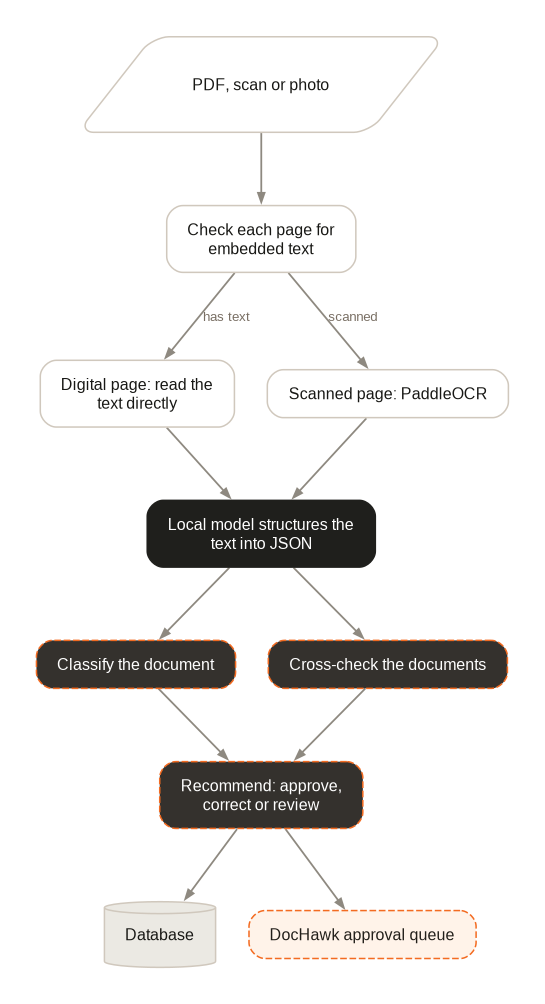
Follow the workflow
STEPS / 10- 01
PDF, scan or photo
Any document: digital, scanned or photographed.
- 02
Check each page for embedded text
PyMuPDF tests every page, so OCR only runs where it is needed.
- 03
Digital page: read the text directly
Fast and exact.
- 04
Scanned page: PaddleOCR
Returns text with confidence scores and bounding boxes.
- 05
Local model structures the text into JSON
Fields such as parties, quantities, weights and HS codes.
- 06
Classify the document
Invoice, packing list, draft bill of lading, final bill of lading or EIR.
- 07
Cross-check the documents
Quantities, weights, parties, HS codes and values must agree.
- 08
Recommend: approve, correct or review
Each recommendation carries its reasons.
- 09
Database
Bill of lading data, shipment state and history.
- 10
DocHawk approval queue
A person decides. Glyph never contacts a carrier.
WHY THIS
DESIGN.
Technology with a specific job.
Use PyMuPDF when the page contains digital text; invoke PaddleOCR for scans. This preserves quality and avoids unnecessary OCR work.
System integrations and capabilities follow the maturity statement above; the diagram is not proof that every stage is deployed.
IMPACT,
WITHOUT
GUESSWORK.
Working extraction and bill-of-lading database storage; validated field accuracy and minutes saved not supplied.
Manual minutes reviewing one bill of lading and accuracy on a signed-off field-level sample.
Document-level baseline review times, reviewed output by field, OCR confidence, exceptions, hours spent correcting records, and volume by document type.
Capacity released, avoided future expenditure and actual cash reductions are distinct. Do not allocate the portfolio-wide 20+ hours/week or 22% result to this individual case without supporting measurement.
OPEN THE AED SCENARIO CALCULATOR