Asta.
My own LLM gateway: one OpenAI-compatible endpoint that routes by task, falls back when a provider runs out and tracks usage.
VIEW THE SYSTEM DESIGNRuns on a VPS and invokes provider models. Unlike Glyph, this is not a guarantee of local-only inference or document residency.
BEFORE
& AFTER.
The manual / previous workflow
Each app integrates separately with model providers and fails abruptly when tokens, quotas or providers run out.
What changed
Running: one OpenAI-compatible endpoint chooses a provider by task and retries another provider after limits or failures.
IMPLEMENTATION BOUNDARY Runs on a VPS and invokes provider models. Unlike Glyph, this is not a guarantee of local-only inference or document residency.
UNDER
THE HOOD.
Built from source-described project workflows. Arrows retain execution and data dependencies.
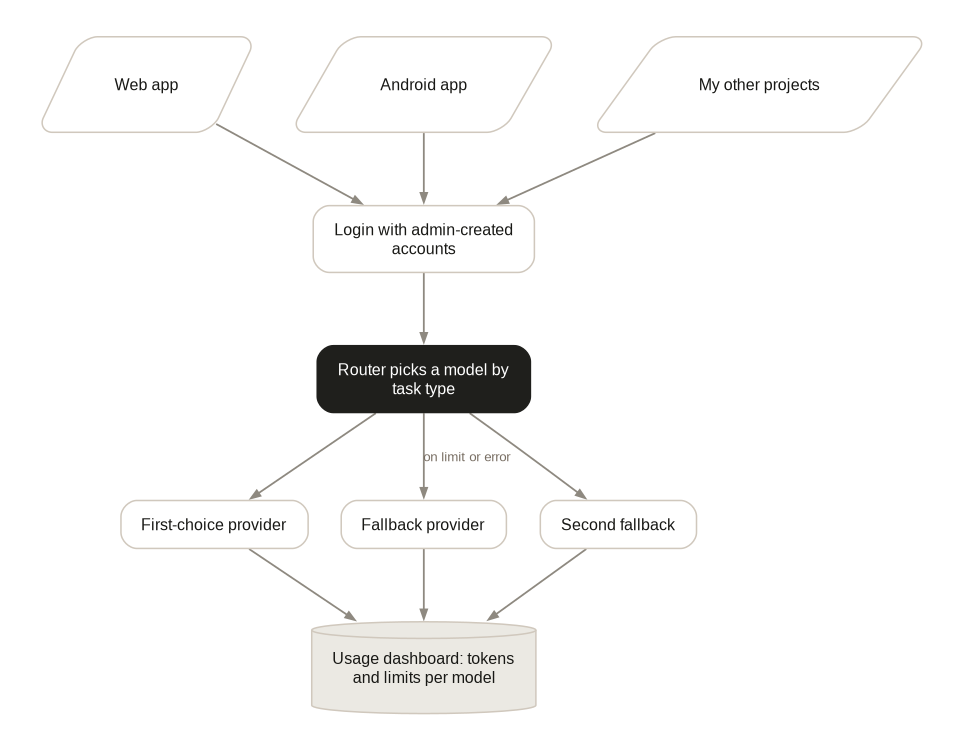
Follow the workflow
STEPS / 09- 01
Web app
Chat, model picker and document upload.
- 02
Android app
The same gateway from any network.
- 03
My other projects
They call it like any OpenAI-style API.
- 04
Login with admin-created accounts
Only accounts I create can get in.
- 05
Router picks a model by task type
Different kinds of task can go to different models.
- 06
First-choice provider
The model best suited to the task.
- 07
Fallback provider
Used when the first choice hits a limit or fails.
- 08
Second fallback
Keeps the request alive if the first two are unavailable.
- 09
Usage dashboard: tokens and limits per model
Shows what is left on each model.
WHY THIS
DESIGN.
Technology with a specific job.
Keep the client interface stable while routing changes behind the gateway. Track usage per provider rather than treating every model as interchangeable.
System integrations and capabilities follow the maturity statement above; the diagram is not proof that every stage is deployed.
IMPACT,
WITHOUT
GUESSWORK.
Running gateway, provider fallback and token dashboard; no matched cost-per-answer baseline documented.
Fully loaded cost per successful, quality-matched request and recovery rate after provider limits.
Request logs, provider bills, success/fallback rates, matched task quality scores and administrator support time.
Capacity released, avoided future expenditure and actual cash reductions are distinct. Do not allocate the portfolio-wide 20+ hours/week or 22% result to this individual case without supporting measurement.
OPEN THE AED SCENARIO CALCULATOR